
- Home
-
![]()
How to Choose a Toothpaste Tablet OEM Partner: An Engineering-Fit Checklist
Views: 0 Author: Site Editor Publish Time: 2026-04-20 Origin: Site
![facebook sharing button]()
![twitter sharing button]()
![line sharing button]()
![wechat sharing button]()
![linkedin sharing button]()
![pinterest sharing button]()
![whatsapp sharing button]()
![kakao sharing button]()
![snapchat sharing button]()
![telegram sharing button]()
![sharethis sharing button]()
TAKEAWAYS
1 decision standard: assess an OEM against your project brief, not against ranking language or generic product catalogues.
5 engineering links: material direction, sensory target, compression behavior, packaging compatibility and approval records must work as one system.
3 sample gates: feasibility sample, pack-fit sample and commercial-SKU approval should answer different questions.
1 transfer rule: a material-level fact or a facility-level credential cannot be converted directly into a finished-product promise.[1] [2]
2 specialist routes: use the compression and batch-release guide for technical specifications and the packaging guide for container and refill decisions.
Start With the Project-Fit Question, Not a Ranked List
A public ranking cannot show whether an OEM can execute your product. It cannot establish whether the proposed material system, tablet experience, packaging concept and release records can work together.
This page therefore does not rank Qiaoerna or any other company. It provides an engineering-fit checklist for a brand that already has a product direction and needs to decide whether an OEM partnership is technically and operationally coherent. If you still need to shortlist suppliers from the beginning, start with the toothpaste tablet manufacturer screening checklist. If China sourcing verification is the immediate question, use the China toothpaste tablet supplier guide.
Engineering question
Evidence to request from the OEM
Decision unlocked
Can the concept be made as a tablet?
Written brief review and feasibility questions
Whether to start a sample route or revise the concept
Can the intended experience be controlled?
Named sensory/handling criteria and a sample plan
What the first sample should test
Can the tablet be compressed and used as intended?
Proposed compression/disintegration review points
What technical evidence should be requested before scale-up
Can the pack work with the tablet?
Pack component assumptions and compatibility review plan
Whether a pack-fit sample is needed
Can production release the approved SKU?
Versioned approval and batch-release route
What must be confirmed before commercial handoff
Problem 1 — A Brand Compares OEMs by Marketing Claims Instead of Project Evidence
A supplier may advertise custom formulas, premium packaging or innovation. Those descriptions are not enough to establish project fit. Send a single, controlled brief to each candidate OEM and compare the questions they ask, the assumptions they identify, and the evidence they propose for the next gate. A suitable partner should identify what is known, what needs testing and what remains unconfirmed before a sample or record exists.
Turn the Brand Concept Into a Manufacturing Brief
An OEM cannot assess feasibility from a broad trend label. Turn the concept into a manufacturing brief that defines the target market, product role, tablet format, formula direction, flavour and appearance intent, expected use context, packaging preference, and the decisions that need evidence. A concise brief reduces uncontrolled sampling and allows the engineering team to flag trade-offs early.
For example, “premium fluoride-free tablet” is a positioning label, not an engineering instruction. A useful brief asks: Which ingredient direction is required? What taste or mouthfeel must be achieved? What tablet presentation is intended? Is the planned pack a jar, tube, pouch, or refill system? What claims and label route will the brand’s reviewers need to consider? Which decision must the first sample answer?
The final regulatory pathway depends on the marketed product’s intended use, claims, formula and labeling. FDA notes that intended use can place a product in the cosmetic, drug or both categories; supplier materials should therefore be treated as project inputs rather than universal compliance promises.[1]
Check Material, Flavour and Appearance Feasibility Before Compression
Material selection, flavour direction and appearance are linked in a solid tablet. An ingredient may have a particular particle behavior, color contribution, taste interaction or moisture sensitivity that changes the development route. The correct question is not whether an ingredient has an attractive story; it is whether the proposed material system can be assessed for the intended tablet and pack under a controlled sample plan.
Ask the OEM to identify the open feasibility questions before it offers a final result. The team should distinguish what is a supplier specification question, what needs a development sample, what requires pack evaluation, and what requires final market review. This creates a transparent decision path without turning an ingredient background fact into a promise about the finished product.
A brand that needs a broad overview of solid oral-care project decisions can also consult the waterless toothpaste tablet OEM guide. Do not use that general guide as a substitute for a project-specific feasibility review.
Problem 2 — A Brand Adds Several New Materials Before It Understands the Tablet System
Adding flavour, color, botanical or functional directions to the same first sample can obscure the real cause of a handling or sensory issue. Ask the OEM to define the fewest variables needed for each sample gate. A decision-focused sample plan is more useful than a large assortment of uncontrolled concepts.
Review Compression, Hardness and Disintegration as One System
Tablet compression is not a single “hardness” target. Compression force, material flow, tablet geometry, lubricant approach, friability, hardness, disintegration, handling and mouthfeel can interact. A tablet that is hard enough for one handling objective may require a different review if it changes the intended disintegration or sensory experience.
Your OEM should explain which physical attributes will be considered for the project, how the proposed sample will be evaluated, and which criteria need agreement before commercial scale-up. It should not promise a universal target without knowing the formula, tablet size, packaging, user experience and manufacturing route.
For the detailed technical framework, use Qiaoerna’s toothpaste tablet compression OEM guide. That specialist page discusses hardness, friability, disintegration, pre-production records and batch-release logic. This engineering-fit page only determines whether the OEM has a coherent path to that review.
![toothpaste tablet OEM.png]()
Problem 3 — A Brand Calls Any Tablet That Looks Intact “Production Ready”
A tablet can look acceptable in a sample jar and still require a defined review before it becomes a commercial SKU. Ask what the sample has demonstrated, what it has not demonstrated, and which physical or packaging questions remain. The value of an engineering-fit discussion lies in identifying that boundary before a brand locks artwork or production quantities.
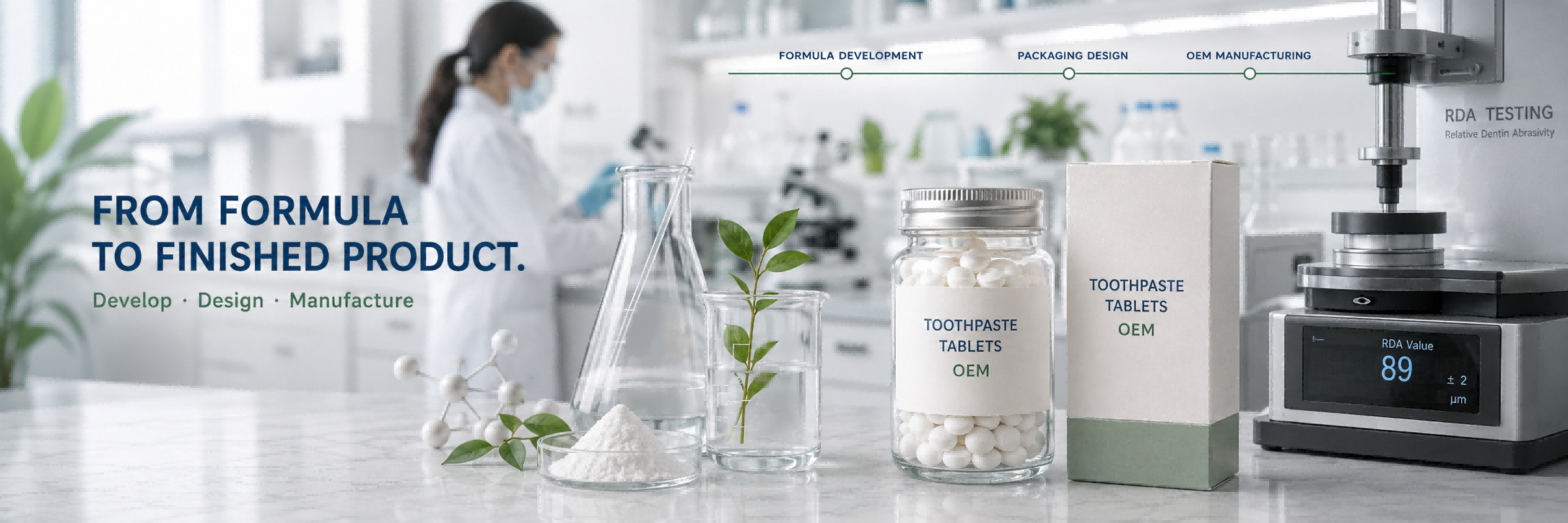
Tablet behavior is reviewed as a linked system, not as a single appearance target.
Include Packaging Compatibility in Product Engineering
Packaging is a functional part of solid oral-care development. It defines the tablet’s storage presentation, pack opening sequence, component interactions, artwork constraints and the questions that must be verified before approval. An OEM engineering comparison should therefore include the pack route from the beginning, not after the formula is described as “final.”
Ask which components are assumed in the sample pack, whether the commercial component is already selected, what changes occur when moving from a test pack to final pack, and who approves the artwork and component version. Avoid claims that a pack is “protective” or “sustainable” without a defined component and relevant project evidence.
For deeper pack-format decisions, consult the toothpaste tablet packaging guide. The OEM engineering-fit checklist should stay focused on confirming that pack questions are included in the project plan.
Packaging compatibility belongs in the engineering route before commercial SKU handoff.
Use Samples to Test Decisions, Not to Collect Uncontrolled Variants
A development sample should have an explicit job. The first sample might assess whether the proposed concept gives the right sensory and handling direction. A second sample might compare a controlled formula or tablet adjustment. A pack-fit sample might assess how the identified tablet route and commercial packaging concept work together. Each stage should identify the sample version, the decision being reviewed, the reviewer and the next action.
An OEM partner demonstrates engineering discipline by explaining why it is sending a particular sample, not by presenting an unlimited menu of options. The brand should capture its feedback in a controlled record so that each next sample can be compared to the one before it.
Approve the Commercial SKU Through a Record-Based Handoff
Before production handoff, the project should have a coherent commercial-SKU identity: approved formula or concept version, tablet presentation, packaging components, artwork version, intended market assumptions, and the release records or checks the parties have agreed to review. The exact content is project-specific, but the principle is stable: approval must point to a defined commercial SKU, not simply to a favourite development sample.
The manufacturer may supply records relevant to its facility and production process. The brand must ensure that its final market, label and claim review matches the product that will actually be placed on the market. In the EU cosmetic model, the Responsible Person maintains a product-specific PIF that includes manufacturing information and proof of the effect claimed; supplier evidence is an input to that wider responsibility.[2]
Know When to Return to Supplier Screening or Move to Specialist Review
Return to the general supplier-screening checklist if the question is still whether a company can support basic MOQ, samples, records and communication. Move to the China supplier verification guide if project ownership, document scope or export handover is the unresolved issue.
Use this page only when the real question is engineering fit: whether the proposed formulation brief, tablet behavior, packaging route, samples and commercial approval records can be joined into one credible OEM pathway.
Request a Toothpaste Tablet OEM Engineering-Fit Brief
Send Qiaoerna your market, product role, formula direction, target tablet experience, packaging concept, current sample history and approval questions. We can structure an OEM discussion around the specific feasibility and record gates your SKU requires. Contact Qiaoerna or email
admin@qiaoerna.com.cn.FAQ: Toothpaste Tablet OEM Engineering Fit
What is the difference between a toothpaste tablet manufacturer and an OEM partner?
A manufacturer may be able to produce a standard tablet. An OEM partner must also show how your specific formula direction, tablet behavior, packaging route, sample decisions and commercial approval records can be managed together.
Why should brands avoid ranked toothpaste tablet manufacturer lists?
A ranking cannot prove project fit. Use a written project brief and compare how each OEM identifies feasibility questions, sample gates, packaging assumptions and approval records for your proposed SKU.
What should be included in a toothpaste tablet engineering brief?
Include the target market, product role, tablet format, formula direction, flavour and appearance intent, planned packaging, sample priorities, claims/label questions and the decisions that need evidence.
Does high hardness mean a toothpaste tablet is better?
No. Hardness is one variable within a system that may also include friability, disintegration, handling, sensory experience, tablet geometry and packaging. The right evaluation depends on the proposed product.
When should packaging be discussed with a toothpaste tablet OEM?
Discuss packaging at the start of the engineering review. The sample pack, commercial component, closure, artwork version and pack-fit questions can affect how the commercial SKU is defined and approved.
Can raw-material information prove a finished product claim?
No. Raw-material information may support formulation discussion, but it cannot by itself prove a finished-product claim. Final product evidence and claim review must match the marketed SKU and applicable route.[1] [2]
What should be approved before commercial production starts?
Approve the defined commercial SKU: formula or concept version, tablet presentation, packaging components, artwork version, market assumptions and the agreed production/release records. Keep those approvals traceable to the final handoff.
Author: Xiaoying, Head of R&D, Qiaoerna Biotechnology Co., Ltd.
Technical review: Qiaoerna Quality & Compliance Team
Updated: 2026-09-14References
[1] U.S. Food and Drug Administration — Is It a Cosmetic, a Drug, or Both? — Explains intended-use classification and why a product’s final claims, formula and labeling matter.
[2] Health Products Regulatory Authority — Product Information File (PIF) — Describes the product-specific PIF and the Responsible Person’s documentation role for EU cosmetic products.
[3] U.S. Food and Drug Administration — Registration & Listing of Cosmetic Product Facilities and Products — States that cosmetic registration/listing is not a product approval or promotional tool.
![Shilajit Toothpaste Tablets]()
![Activated Charcoal Clove Mint Toothpaste Tablets]()
![Custom Purple Color-Changing Toothpaste Tablets]()
![Private Label CoQ10 Toothpaste Tablets Manufacturer]()
![Probiotic Coconut Toothpaste Tablets with Hydroxyapatite]()


