

- Home
-
![]()
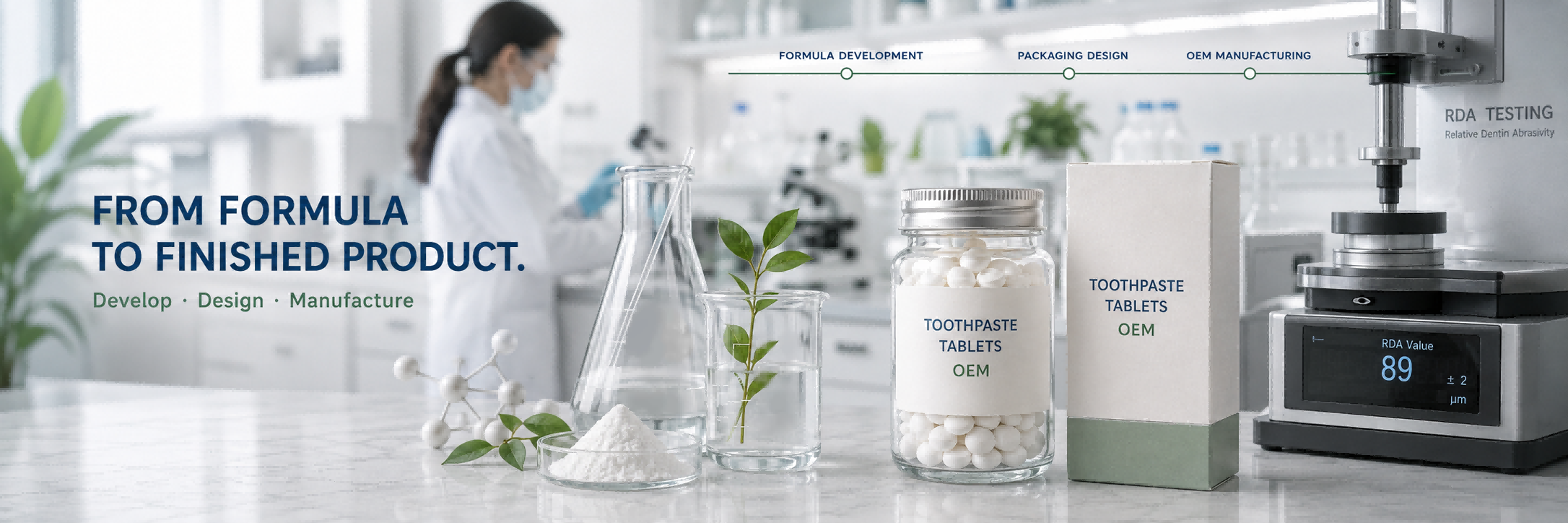
2026 Deep Dive: Why Qiaoerna’s Toothpaste Tablet Factory is Redefining Oral Care for Sensitive Teeth
Views: 0 Author: Site Editor Publish Time: 2026-01-27 Origin: Site
![facebook sharing button]()
![twitter sharing button]()
![line sharing button]()
![wechat sharing button]()
![linkedin sharing button]()
![pinterest sharing button]()
![whatsapp sharing button]()
![kakao sharing button]()
![snapchat sharing button]()
![telegram sharing button]()
![sharethis sharing button]()
The global oral care landscape of 2026 is no longer defined by the simple shift from tubes to tablets. It has evolved into a sophisticated arena of functional bio-materials and precision manufacturing. As consumers move away from "mass-market" solutions toward "personalized dental health," one specific segment has remained notoriously difficult to satisfy: the sensitive teeth market.
For the estimated 38% of the global adult population suffering from Dentin Hypersensitivity (DH), the early generations of toothpaste tablets were a failure—often too abrasive, chemically aggressive, or physically unstable. Today, we conduct a deep-dive analysis into the Qiaoerna Advanced Manufacturing Hub, exploring how their 2026 proprietary formula and pharmaceutical-grade production lines have finally solved the "Sensitivity Paradox."
Part I: The 2026 Market Context – The Death of "Generic" Eco-Care
In 2026, sustainability is no longer a "premium feature"—it is a regulatory and social baseline. The real battleground for brands is clinical efficacy. The era of "chalky," DIY-style toothpaste tablets is over. Professional-grade solid galenics are now expected to match the fluoride delivery, foaming capacity, and desensitizing power of traditional professional pastes.
Qiaoerna has identified that "Sensitive Care" is the fastest-growing sub-sector in the solid oral care market. However, producing a desensitizing tablet is significantly more complex than producing a standard one. It requires a mastery of powder rheology, active ingredient stabilization, and controlled abrasivity (RDA).

Part II: The Science of the Qiaoerna Formula – A Molecular Perspective
To understand why Qiaoerna’s tablets are superior for sensitive teeth, we must look at the microscopic interaction between the tablet and the tooth surface.
1. The n-HAp Revolution: Biomimetic Remineralization
While traditional desensitizing pastes often rely on Potassium Nitrate ($KNO_3$) to chemically "numb" the nerve, Qiaoerna utilizes Nano-Hydroxyapatite (n-HAp) as its core active agent.
Technical Insight: The human tooth enamel is $97\%$ Hydroxyapatite. Qiaoerna’s factory produces a synthesized biomimetic version with a particle size of $20-50$ nanometers.
At this scale, the particles exhibit a high affinity for dentin. When the tablet is chewed and mixed with saliva, these nanoparticles migrate into the exposed dentinal tubules—the microscopic "tunnels" that lead to the nerve. By physically plugging these tubules, Qiaoerna’s formula creates a permanent mineral barrier, providing long-term relief rather than a temporary chemical fix.
2. The pH-Neutral Surfactant System
Traditional tablets often use Sodium Lauryl Sulfate (SLS), a high-HLB surfactant that creates foam but also strips the oral mucosa of its protective lipid layer, exacerbating sensitivity.
Qiaoerna’s 2026 formula has entirely transitioned to Amino Acid Surfactants, specifically Sodium Cocoyl Glutamate.
Biological Compatibility: These surfactants are non-ionic and maintain the oral microbiome's delicate balance.
The pH Factor: The factory’s chemists have stabilized the tablet’s internal environment to maintain a post-dissolution pH of $7.0 \pm 0.2$. This neutrality is crucial for sensitive users, as acidic environments ($pH < 5.5$) trigger immediate pain and further demineralization.

Part III: Engineering Excellence – Inside the Qiaoerna Factory
Professionalism is not just about the recipe; it is about the repeatability and purity of the manufacturing process. Qiaoerna’s 2026 facility is a testament to Industry 4.0.
1. Fluidized Bed Granulation (FBG) Technology
Standard factories use "Direct Compression," which often leads to tablets that are too hard to chew or too crumbly to ship. Qiaoerna utilizes Fluidized Bed Granulation.
In this process, the active ingredients (n-HAp, Xylitol, and Fluoride) are suspended in a warm air column while a liquid binder is sprayed. This creates "micro-sponges" or granules.
Benefit for Sensitivity: This ensures an instantaneous dissolution rate (less than 3 seconds). For a sensitive user, the faster the tablet turns into a smooth foam, the less mechanical friction is applied to the painful areas of the teeth.
2. Smart-Press Density Control
If a tablet is too dense, the user has to bite down hard, which can be painful for those with fractured enamel or sensitive gum lines. Qiaoerna’s presses are equipped with AI-driven pressure sensors that measure the resistance of every single tablet.
Consistency: Every tablet is pressed with exactly $12$kN to $15$kN of force, ensuring a "soft-crunch" texture that is accessible even for those with dental fragility.
3. ISO-7 (Class 10,000) Pharmaceutical Environment
Sensitive teeth are often accompanied by sensitive or receding gums, which are more prone to infection. Qiaoerna’s tablets are manufactured in an ISO-7 Cleanroom.
Zero Contamination: This level of air filtration removes $99.9\%$ of airborne particulates, allowing the factory to use fewer synthetic preservatives. This results in a "cleaner" label that appeals to the 2026 "Clean Beauty" consumer.
Part IV: Abrasivity Management – The RDA Breakdown
Relative Dentin Abrasivity (RDA) is the industry standard for measuring how much a toothpaste wears down the tooth. For sensitive teeth, a high RDA is catastrophic.
Component Standard Tablet Qiaoerna 2026 Sensitive Abrasive Agent Calcium Carbonate (Jagged) Spherical Micro-Silica Particle Shape Irregular / Sharp Perfectly Spherical RDA Value $120 - 150$ $45 - 55$ Clinical Effect Aggressive cleaning Gentle Polishing By using spherical silica, Qiaoerna ensures that the cleaning action is based on "rolling" away plaque rather than "scrubbing" away the enamel. This is the hallmark of a factory that understands dental histology.

Part V: Why Global Brands are Choosing Qiaoerna as an OEM Partner
In the competitive landscape of 2026, brand owners cannot afford a product recall or a "bad mouthfeel" review. Qiaoerna provides a "Safety-First" manufacturing partnership.
1. Rapid R&D and Prototyping
Qiaoerna’s in-house laboratory can take a brand's concept and produce a stabilized, lab-tested sample in under 14 days. Whether it is adding CBD for gum inflammation or Zinc Citrate for breath control, the factory’s "modular" formula allows for rapid customization without compromising the anti-sensitivity base.
2. Stability Testing and Shelf-Life Assurance
One of the biggest hurdles for toothpaste tablets is moisture. Qiaoerna’s Advanced Stability Chambers simulate 3 years of tropical humidity in 3 months. This ensures that the desensitizing agents (like n-HAp) do not degrade or clump over time, a common failure in lower-tier factories.
3. Sustainable Supply Chain Transparency
In 2026, the "Story" behind the product matters. Qiaoerna provides full traceability of its ingredients, from the sustainably sourced Xylitol to the FSC-certified packaging. This level of transparency is essential for brands looking to achieve B-Corp status or premium shelf placement in stores like Whole Foods or Sephora.
Part VI: Conclusion – The Future of Solid Oral Care
The transition to toothpaste tablets is no longer a trend; it is a fundamental shift in the global FMCG (Fast-Moving Consumer Goods) sector. However, as the market matures, the winners will be the brands that can deliver specialized solutions.
Qiaoerna has proven that through a combination of nano-material science, pharmaceutical-grade manufacturing, and a deep understanding of dental sensitivity, a tablet can actually outperform traditional paste. By lowering RDA values, utilizing n-HAp for physical repair, and maintaining a sterile production environment, Qiaoerna is not just making tablets—they are engineering the future of dental health.
Transform Your Brand with Qiaoerna
The demand for sensitive-friendly, high-performance toothpaste tablets is skyrocketing. Partner with the factory that defines the 2026 standard.
Are you ready to see the clinical data? We can provide comprehensive RDA reports and SEM (Scanning Electron Microscope) images of our n-HAp tubule occlusion.
Need a Sample? Contact our global partnership team today to receive a 2026 Sample Kit, including our Mint-Repair and Charcoal-Sensitive lines.
Would you like me to draft a specific Technical White Paper for your R&D team, or shall we schedule a 1-on-1 consultation with our lead formulation chemist?
![Prebiotic Toothpaste Tablets for Oral Microbiome Balance]()
![test0124]()
![Anhydrous Prebiotic Toothpaste Tablets (Inulin & FOS Bio-Delivery System) 2026]()
![Test]()
![Nocturnal Source Tart Cherry Sleep Toothpaste Tablets]()
![Daily-Use & Stability-Optimized Engineered Toothpaste Tablets]()
![Tart Cherry Sleep Toothpaste Tablets]()
![Nano Hydroxyapatite Toothpaste Tablets]()


