
- Home
-
![]()
Why Toothpaste Tablet Samples Pass, But Bulk Orders Fail: A Private Label Buyer’s Checklist
Views: 0 Author: Xiaoying Publish Time: 2026-06-17 Origin: Site
![facebook sharing button]()
![twitter sharing button]()
![line sharing button]()
![wechat sharing button]()
![linkedin sharing button]()
![pinterest sharing button]()
![whatsapp sharing button]()
![kakao sharing button]()
![snapchat sharing button]()
![telegram sharing button]()
![sharethis sharing button]()
For many private label oral care brands, toothpaste tablets look simple at the sample stage.
A few tablets arrive in a small jar. The shape looks clean. The mint flavor feels fresh. The tablets foam well enough during a quick brushing test. The packaging also fits a plastic-free or zero-waste brand story.
At that moment, it is easy to think the project is ready for bulk production.
But toothpaste tablets are not only about making a good sample. The real test starts when the formula is produced in larger batches, packed in final packaging, shipped overseas, stored for months, and used by customers every day.
This is where some private label toothpaste tablet projects begin to fail.
A sample can look good, but a bulk order may still face problems such as crumbling, powder at the bottom of the jar, weak flavor, moisture absorption, tablets sticking together, unstable hardness, or packaging that does not protect the product well enough.
For brand owners, the key question is not only: “Do I like this sample?”
A better question is: “Can this sample be produced consistently as a stable bulk order?”
Key Takeaways
Toothpaste tablet samples can pass early approval but still fail during bulk production, shipping, or storage.
The most common risks are tablet hardness, crumbling, moisture protection, flavor stability, and packaging sealing.
Toothpaste tablets need more moisture control than traditional toothpaste because they are compressed solid tablets.
Eco-friendly packaging is important, but it must also protect the tablets from humidity.
Private label buyers should review a bulk order checklist before confirming mass production.
A reliable toothpaste tablet OEM manufacturer should help brands reduce production risk, not only provide a low price.
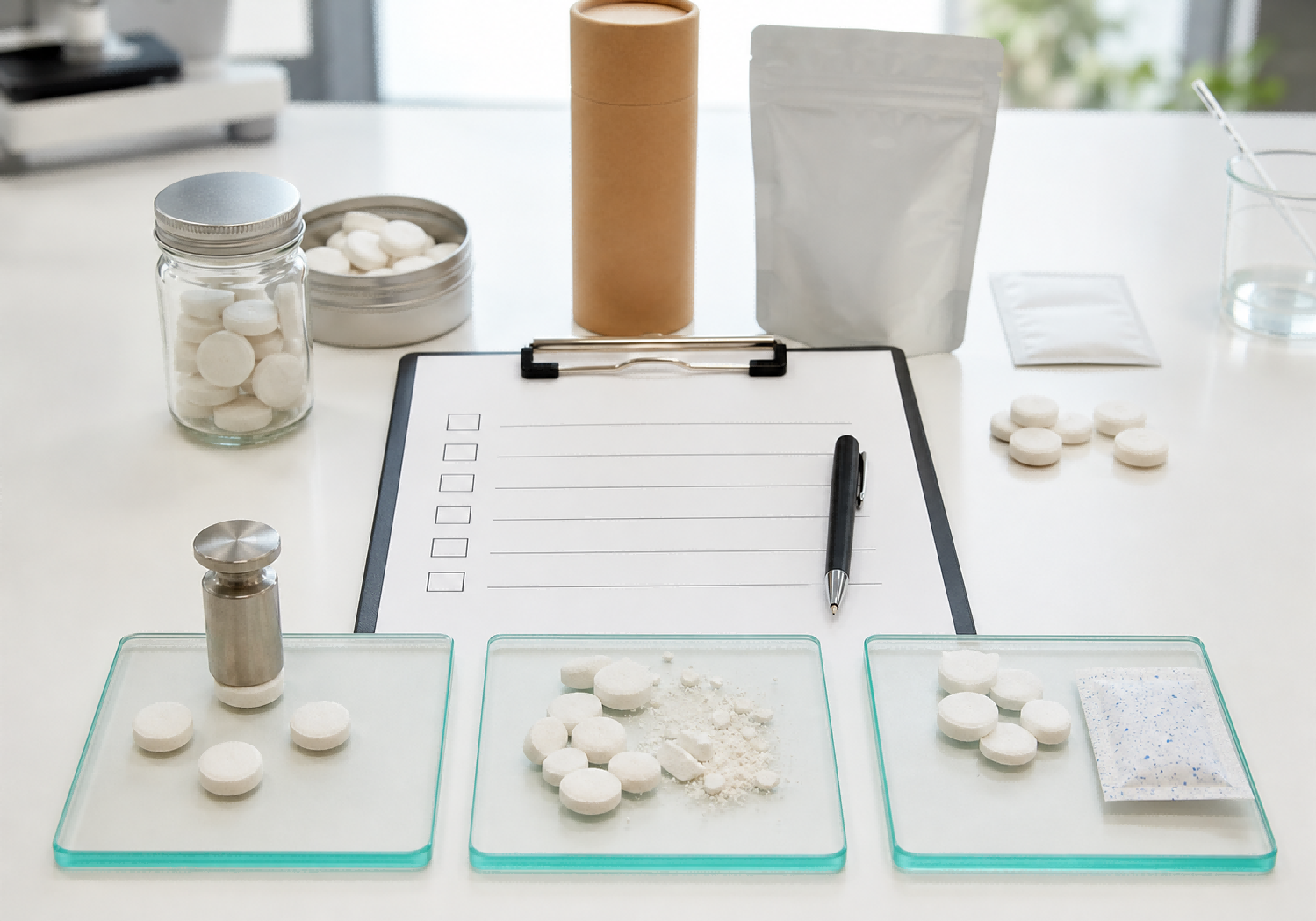
![Toothpaste tablet samples and bulk order quality checklist for private label oral care brands]()
Why Samples and Bulk Orders Can Be Different
A sample is usually made in a small quantity. It is easier to adjust the flavor, tablet weight, color, hardness, and packaging presentation during the sample stage.
Bulk production is different.
A real bulk order involves larger powder mixing, continuous tablet compression, packaging speed, transportation vibration, warehouse humidity, and batch-to-batch consistency.
Small problems that are not obvious in a sample can become much larger when the order reaches tens of thousands or hundreds of thousands of tablets.
For example, a mint flavor may be strong when the sample is fresh, but become weaker after two months of storage. A tablet may feel fine during a quick test, but break easily during shipping. A paper tube may look perfect in a product photo, but fail to protect tablets in a humid warehouse.
This is why private label buyers should not approve toothpaste tablets only by appearance and taste. They should also check whether the formula, compression process, and packaging can support stable bulk production.
Mistake 1: Only Checking the Look of the Tablet
A clean shape is important, but it is not enough.
Toothpaste tablets need the right balance between strength and user experience. If the tablet is too hard, customers may feel like they are biting a medicine tablet. If it is too soft, the tablets may break, chip, or create powder during shipping.
Before confirming a bulk order, buyers should check:
Can the tablet be bitten comfortably?
Does it leave too much powder in the jar?
Are the tablet edges easy to chip?
Does the tablet break during basic handling?
Is the hardness consistent across different samples?
For toothpaste tablets, harder is not always better. Softer is not always better either. The goal is a tablet that can survive shipping while still giving customers a comfortable brushing experience.
Mistake 2: Ignoring Crumbling and Dusting
Crumbling is one of the most common issues in toothpaste tablet products.
Even if most tablets remain complete, powder at the bottom of the jar can make the product feel cheap or poorly made. For premium oral care brands, this can damage customer trust before the first use.
Crumbling can be caused by formula balance, compression pressure, tablet shape, packaging movement, or weak protection during transportation.
Private label buyers should not only inspect the top layer of the sample jar. They should also shake the packaging lightly, check the bottom of the container, and review how the tablets look after transportation.
A good toothpaste tablet should not create excessive powder under normal handling conditions.
Mistake 3: Choosing Packaging for Sustainability but Not Moisture Protection
Packaging is one of the biggest selling points of toothpaste tablets. Glass jars, aluminum tins, paper tubes, refill pouches, and plastic-free packaging can all support a strong sustainability story.
But toothpaste tablets are moisture-sensitive.
If the packaging does not protect the tablets from humidity, the product may become soft, sticky, cracked, or unstable. In some cases, tablets may absorb moisture after repeated opening and closing by the consumer.
Packaging comparison:
Packaging Option
Main Advantage
Quality Risk to Check
Glass jar
Premium look, reusable, strong shelf appeal
Cap sealing and moisture control
Aluminum tin
Lightweight, modern, travel-friendly
Lid closure and internal movement
Paper tube
Strong plastic-free positioning
Inner lining and moisture barrier
Refill pouch
Good for subscription and repeat purchase
Material barrier and sealing strength
Sachet
Good for travel, hotel, or sampling
Cost, waste, and single-use positioning
For private label brands, packaging should not only look sustainable. It must also protect the formula.
A beautiful package that cannot protect the tablets is not a good package.
Mistake 4: Not Testing Flavor Stability
Flavor is one of the first things consumers notice.
A toothpaste tablet may have a strong mint, spearmint, fruit, herbal, or natural flavor when the sample is fresh. But flavor can change during storage, especially when the formula uses volatile flavors or essential oil-based ingredients.
Private label buyers should ask:
Will the flavor remain stable after storage?
Does the packaging help reduce flavor loss?
Does the tablet taste the same after several weeks?
Will the flavor interact with other ingredients?
Can the same flavor level be repeated in bulk production?
This is especially important for brands selling through Amazon, retail stores, subscription boxes, or overseas distributors. Products may spend months in storage before reaching the final customer.
A fresh sample is not the same as a product after real supply chain conditions.
Mistake 5: Adding Too Many Claims Into One Formula
Many new oral care brands want one toothpaste tablet to do everything.
They may ask for a formula that is fluoride-free, whitening, natural, probiotic, sensitivity-friendly, enamel-supporting, plastic-free, vegan, and suitable for kids at the same time.
This sounds attractive from a marketing perspective, but it can create formulation risk.
Every ingredient affects tablet compression, taste, mouthfeel, stability, cost, and regulatory positioning. High mineral content may affect texture. Some botanical ingredients may affect color or smell. Sweeteners, foaming agents, flavors, and active ingredients must be balanced carefully.
For a first product launch, a clearer positioning is usually safer.
A brand can choose one main direction, such as:
Plastic-free daily toothpaste tablets
Fluoride toothpaste tablets for cavity protection positioning
Fluoride-free toothpaste tablets with nano hydroxyapatite
Travel-friendly oral care tablets
Kids toothpaste tablets
Premium mint toothpaste tablets for refill systems
A focused formula is easier to produce, easier to explain, and easier for customers to understand.
Mistake 6: Skipping Bulk Order Quality Checks
Before confirming mass production, private label buyers should use a checklist instead of relying only on sample approval.
Quality Check
Why It Matters
Tablet hardness
Affects chewing experience and breakage risk
Crumbling and dusting
Affects product appearance and customer trust
Disintegration feel
Affects brushing comfort and mouthfeel
Flavor stability
Affects first impression and repeat purchase
Moisture protection
Affects shelf life, storage, and shipping stability
Packaging sealing
Affects humidity control and flavor protection
Batch consistency
Affects long-term brand reliability
Label and documents
Affects import, retail, and compliance review
MOQ and sampling process
Affects launch budget and production planning
This checklist does not require the buyer to become a technical expert. It helps the buyer ask better questions before placing a bulk order.
The conversation with a toothpaste tablet manufacturer should not stop at price, MOQ, and delivery time. It should also cover product stability, packaging performance, and how the factory controls quality from sample to bulk production.
What a Reliable Toothpaste Tablet OEM Manufacturer Should Explain
A reliable OEM manufacturer should not only say, “Yes, we can make it.”
They should also explain what may affect the product during production, shipping, and storage.
For example, a good toothpaste tablet supplier should be able to discuss:
Standard and custom formula options
Fluoride and fluoride-free formula directions
Nano hydroxyapatite toothpaste tablet development
Flavor, color, shape, and tablet weight customization
Moisture-sensitive packaging choices
Glass jar, paper tube, aluminum tin, pouch, and refill packaging options
Sampling process before bulk production
Batch control during mass production
COA, MSDS, and other basic documents
Label and claim considerations for target markets
For private label buyers, choosing a manufacturer is not only about finding the lowest unit cost. It is about choosing a supplier that can reduce product development risk.
How Qiaoerna Supports Private Label Toothpaste Tablet Projects
Qiaoerna supports overseas oral care brands with toothpaste tablet OEM and ODM manufacturing, including formula development, flavor customization, tablet shape options, packaging selection, private label production, and export document support.
If you are planning to develop private label toothpaste tablets, we usually recommend confirming three points before bulk production.
First, what is the product positioning? Is the product designed for zero-waste oral care, travel oral care, kids oral care, daily family brushing, or premium refillable oral care?
Second, what is the formula direction? Should the formula use fluoride, be fluoride-free, include nano hydroxyapatite, focus on xylitol, or support another functional positioning?
Third, can the packaging protect the tablets? The package should match your brand image, but it also needs to protect tablets from moisture, flavor loss, and shipping damage.
When these questions are answered during the sample stage, the risk of bulk order problems becomes much lower.
Final Thoughts
Toothpaste tablets can be a strong product for private label oral care brands, especially for companies focused on sustainable packaging, travel convenience, and product differentiation.
But a good sample is only the beginning.
Before placing a bulk order, brands should check tablet hardness, crumbling, disintegration feel, flavor stability, moisture protection, packaging sealing, batch consistency, and compliance documents.
The best toothpaste tablet projects are not built only on attractive packaging or trendy claims. They are built on stable formulation, practical packaging, and a manufacturer that understands how to move from sample approval to reliable bulk production.
FAQ
Why do toothpaste tablet samples pass but bulk orders fail?
Samples are made in small quantities and are easier to adjust. Bulk orders must go through larger-scale mixing, tablet compression, packaging, shipping, storage, and batch control. Problems that are not obvious in samples can become clear during mass production.
What are the most common toothpaste tablet quality problems?
Common issues include crumbling, powder at the bottom of the jar, moisture absorption, tablets sticking together, weak flavor, unstable hardness, slow disintegration, and poor packaging sealing.
Are paper tubes suitable for toothpaste tablets?
Paper tubes can be suitable for toothpaste tablets, especially for plastic-free brands. However, the tube must have proper inner protection and sealing to help reduce moisture risk.
What should private label buyers check before placing a bulk order?
Buyers should check tablet hardness, crumbling, disintegration feel, flavor stability, packaging sealing, moisture protection, batch consistency, MOQ, sampling process, and basic documents such as COA and MSDS.
Can toothpaste tablets be customized for private label brands?
Yes. Toothpaste tablets can be customized by formula, flavor, color, shape, tablet weight, packaging, label design, and market positioning, depending on MOQ and manufacturing requirements.
What packaging is best for toothpaste tablets?
There is no single best packaging for every brand. Glass jars, aluminum tins, paper tubes, refill pouches, and sachets can all work, but the best choice should balance brand positioning, moisture protection, cost, shipping, and customer experience.
![Purple Probiotic Toothpaste Tablets for Daily Oral Care | Solid Toothpaste Tablets]()
![SP-8 Probiotic Toothpaste Tablets with Hydroxyapatite]()
![Blue & White Color-Dual Toothpaste Tablets for Daily Whitening & Enamel Repair]()
![Cinnamon & Miswak Tooth Powder]()