
- Home
-
![]()
Private Label Toothpaste Tablet Portfolio: Building Fluoride + N-HAp SKUs Without Customer Confusion
Views: 0 Author: Xiaoying Publish Time: 2026-08-18 Origin: Site
![facebook sharing button]()
![twitter sharing button]()
![line sharing button]()
![wechat sharing button]()
![linkedin sharing button]()
![pinterest sharing button]()
![whatsapp sharing button]()
![kakao sharing button]()
![snapchat sharing button]()
![telegram sharing button]()
![sharethis sharing button]()
TAKEAWAYS
Give each of the 2 SKUs one primary shopper job. A portfolio fails when both products claim to be the complete answer for every routine.
Use 3 shopper questions before any ingredient explanation: “What is my priority?”, “Which formula fits it?”, and “What do I buy next?”
Separate only 4 visible signals: product name, task icon, color system, and front-label action line. Shared assets should still make the line feel like one brand.
Build 1 trial-to-full-size route. A selection kit should help a shopper choose, not create another confusing third SKU.
Ask the OEM for a 5-part launch file set: formula brief, artwork matrix, claim review, sample matrix, and batch/packaging release record.
A fluoride tablet and a nano-hydroxyapatite toothpaste tablet can sit under one brand. They should not tell the same story. If both labels say “enamel,” “daily protection,” “sensitive,” and “clean,” the buyer has no decision path.
Start with one question: Which role does each SKU play, and how will a shopper recognize it in 5 seconds? A fluoride route may be conventional and pharmacy-style; an n-HAp route may be fluoride-free and mineral-care focused. These are planning hypotheses, not universal claims. Review final labels and claims market by market.[1] [2]
What Is a Private Label Toothpaste Tablet Portfolio?
A private label toothpaste tablet portfolio is an intentionally connected group of products. It is not a collection of separate formulas launched because the brand wants more choices.
For a two-SKU system, a brand needs three layers of clarity:
Layer
Fluoride SKU example
n-HAp SKU example
What must remain shared
Portfolio role
Core daily-care route
Fluoride-free mineral-care route
Brand promise and tablet format
Shopper task
“Choose this if you want a conventional fluoride route”
“Choose this if you prefer a fluoride-free mineral route”
One plain-language choice framework
Brand system
One task color and icon
A second task color and icon
Logo, bottle shape, tone, tablet count, quality cues
The point is not to make a clinical verdict on the shelf. It is to make the choice legible. Ingredient science, claim substantiation, and applicable classification must be handled separately from the consumer-facing decision path.
A product line also needs a hierarchy. Decide which SKU is the hero and which is the extension. A new brand often starts with one core product, validates demand, then introduces the second route with a deliberate reason. Launching two formula options without a hierarchy can double the artwork, inventory, customer-service, and content work before either item has earned repeat purchase.
Why Product-Line Clarity Is a Commercial Quality Issue
SKU differentiation is not a post-formula marketing task. It affects PDP conversion, selection kits, fulfillment, and customer support. If a trial pack has two unfamiliar products but no next-step instruction, it distributes uncertainty rather than reducing it.
Use one internal test: Can a new team member explain the difference in 20 seconds without calling either product inferior? If not, the line is not ready for an Amazon PDP, pharmacy shelf, or DTC landing page.
Problem #1: Both SKUs Promise Everything
Cause: competing “all-in-one” claims
The common error is to give both products the same vocabulary: “enamel support,” “fresh breath,” “sensitive,” “clean,” “family,” and “daily.” These may be compatible attributes, but they do not create a choice. The page then turns into a technical fluoride-versus-n-HAp contest instead of a purchase journey.
Manufacturing solution: create a role brief before formula lock
The OEM brief should define one primary role and up to two secondary, legally reviewed descriptors per SKU. For example, the fluoride route may be framed around a conventional daily-care routine where permitted. The n-HAp route may be framed around a fluoride-free mineral-care preference, subject to claims review. Neither should be presented as the brand’s “better” formula.
Before sample approval, require a role brief with these 5 fields:
Hero or extension SKU status.
Primary shopper task.
Formula route and market restrictions.
Approved front-label action line.
Product-page comparison sentence.
This is a private label oral care assortment planning document, not a creative mood board. It prevents formula, artwork, and sales teams from creating different definitions of the same SKU.
Problem #2: Packaging Differentiates by Color Only
Cause: visual separation without a naming architecture
Different colors help only after a shopper knows what they mean. A blue bottle and a green bottle do not explain a fluoride and fluoride-free line. Naming should move from the simplest decision to ingredient detail: place an actionable product role first and the active system underneath as a substantiated descriptor.
Manufacturing solution: use a 4-signal packaging system
A well-controlled two-SKU system separates only four signals:
Signal
What it answers
Control point for the OEM
Product name
What routine is this for?
One master naming sheet for all markets
Task icon
What should I notice first?
Same icon size and position across both packs
Color family
Which route am I holding?
Approved Pantone/CMYK/digital color matrix
Action line
What is my next decision?
Claim and copy approval before printing
Keep the jar shape, tablet count, logo position, information hierarchy, and material quality consistent. The line should look related at a distance and different at the hand.
Problem #3: Every Channel Shows the Same Two Products the Same Way
Cause: no channel-specific shopper journey
Amazon, DTC, pharmacy, and dental channels do not ask the shopper to make the choice in the same way. Copying the same comparison image, product title, and bundle into all four channels wastes the advantages of each channel.
Manufacturing solution: define 4 channel playbooks before production
Channel
Best role for the two-SKU system
What the buyer needs first
Amazon
Two distinct PDPs plus a comparison module
A fast “choose your route” answer in images and bullets
DTC
One collection page, routine selector, and selection kit
Guided education, email follow-up, and full-size conversion
Pharmacy / retail
Clear shelf blocking and short task cues
Readable pack differentiation at shelf distance
Dental / professional sampling
Controlled discussion starter, not a claim-heavy brochure
Formula facts, labeling status, and a professional sample matrix
The same rule applies to trials. A toothpaste tablet trial kit strategy should contain a selection instruction before it contains a discount. A practical toothpaste tablet bundle strategy may use two clearly labeled 3-day routes, one comparison card, and one next-step code. The kit is not a third formulation; it converts trial into the correct full-size SKU.
Canary’s public tablet sample format demonstrates the basic commercial logic of a short, measured trial followed by larger packs and replenishment options.[3] A private label dual-SKU kit should improve on that model by making the selection rule explicit rather than asking the customer to infer it.o
![private label toothpaste tablet.png]()
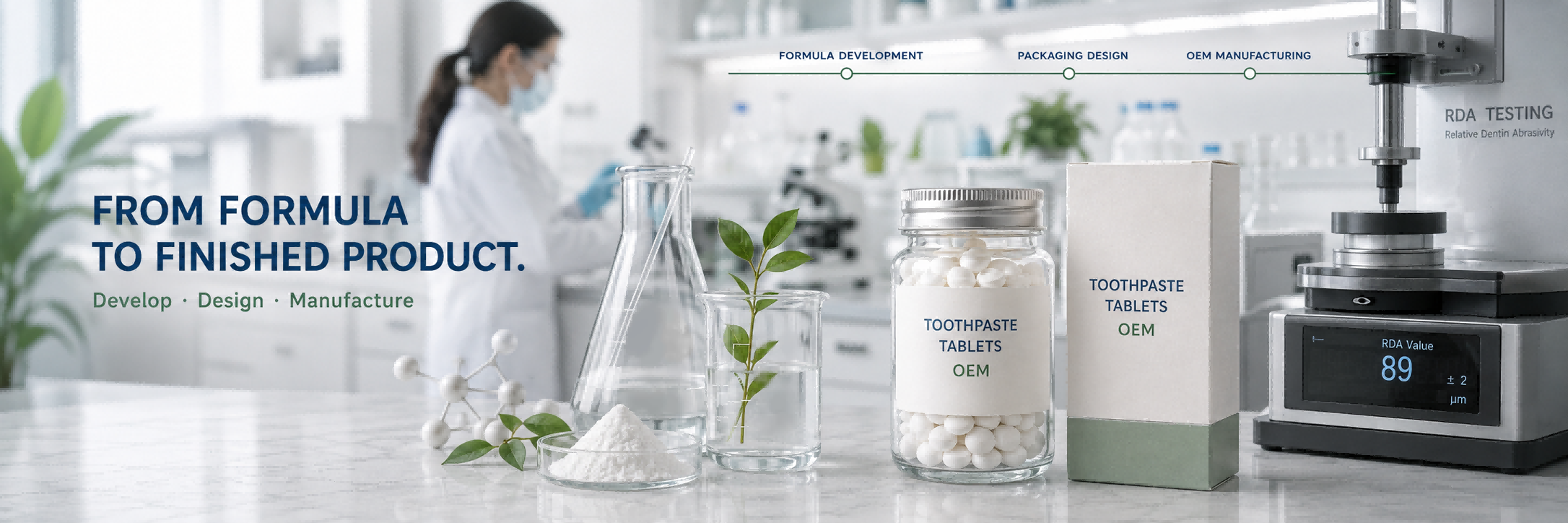
Artwork color control, sample-kit selection logic, and pack-out verification should be reviewed as one two-SKU release system.
Regulatory Compliance: Build the Claims System Before the Portfolio Story
An attractive “choose your route” structure does not remove regulatory review. In the United States, a toothpaste making drug claims may fall within the OTC drug framework; EU cosmetic claims must meet common criteria for legal compliance, truthfulness, evidential support, honesty, fairness, and informed decision-making.[1] [2]
Do not imply that fluoride-free is automatically safer, fluoride is the only effective route, or either formula treats a condition. The portfolio should communicate choice architecture, while the formula file documents active system, label status, substantiation, warnings, and market-specific artwork.
How to Evaluate a Toothpaste Tablet Manufacturer for a Two-SKU Launch
A capable toothpaste tablets OEM should help the brand manage the relationship between two products, not just produce two batches. Ask for a 5-part two-SKU launch file:
Formula matrix: active route, excipient system, flavor, color, tablet specification, and market designation for each SKU.
Sample matrix: version code, sensory notes, tablet count, packaging format, and approval status for each sample.
Artwork matrix: front-label name, color code, icon, legal copy, barcode, market, and revision history.
Claims review log: approved / pending / rejected copy, plus market and reviewer record.
Release matrix: final formula code, packaging components, batch code format, retained samples, and shipment destination.
For private label toothpaste tablets, Qiaoerna supports formulation briefing, toothpaste tablet sampling, packaging differentiation, and production-readiness checks for fluoride toothpaste tablets and hydroxyapatite toothpaste tablets. Submit one portfolio brief—not two unrelated product requests—to admin@qiaoerna.com.cn.
FAQs: Private Label Toothpaste Tablet Portfolio Planning
What is the toothpaste tablet MOQ for a private label toothpaste tablets portfolio?
MOQ depends on formula complexity, tablet count, packaging, print method, and whether components are shared. Brands should request an MOQ comparison for three cases: two fully independent SKUs, two SKUs with a shared jar, and a trial kit using shared outer packaging. The lowest MOQ is not always the lowest-risk launch option.
Should brands launch fluoride and n-HAp toothpaste tablets at the same time?
Not always. Launch both only if the brand can explain the distinction in one short comparison, fund two sets of inventory, and support two compliant product pages. Otherwise, validate a hero SKU first, then add the extension once the product narrative and replenishment behavior are understood.
How does toothpaste tablet sampling work through a two-SKU trial kit?
Use a short, clearly labeled trial for each route, a simple “choose your routine” card, and one direct path to the right full-size pack. Do not introduce extra flavors, claims, or unrelated products into the first kit.
Can the two SKUs share packaging?
They can share a base jar, closure, refill format, and material system if the finished products are compatible. They should not share indistinguishable front labels. Request packaging compatibility and artwork-control checks for each formula and market.
What toothpaste tablet certifications and documents should an OEM provide before launch?
Request formula specifications, ingredient/claims documentation appropriate to the market, artwork approvals, sample approvals, packaging specifications, batch records, retained-sample procedure, and a written production/lead-time plan.
What is the toothpaste tablet lead time for a two-SKU custom toothpaste tablets launch?
Timing changes with formula status, packaging readiness, claims review, artwork, testing, component supply, and production scheduling. Map the 5 launch files first; production cannot be scheduled accurately until both formula and packaging controls are released.
Conclusion
The strongest fluoride + n-HAp portfolio is not the one with the longest scientific comparison. It is the one where a shopper sees two clear routes, tries the right option, and repurchases without re-reading a chemistry lesson. For a private label toothpaste tablet brand, that clarity starts in the OEM brief and continues through artwork, samples, channels, and batch release.
References
U.S. Food and Drug Administration. Is It a Cosmetic, a Drug, or Both? (Or Is It Soap?) https://www.fda.gov/cosmetics/cosmetics-laws-regulations/it-cosmetic-drug-or-both-or-it-soap
Regulatory basis: Product classification depends on intended use and claims; cosmetics and drugs are regulated differently in the United States.European Commission. Commission Regulation (EU) No 655/2013: Common Criteria for the Justification of Claims Used in Relation to Cosmetic Products. https://eur-lex.europa.eu/legal-content/EN/TXT/?uri=CELEX:32013R0655
Regulatory basis: Cosmetic claims must meet criteria including legal compliance, truthfulness, evidential support, honesty, fairness, and informed decision-making.Canary Clean Products. Canary Toothpaste Tablets – Trial Samples. https://www.canarycleanco.com/products/canary-toothpaste-tablets-trial-samples
Market observation: A public example of a measured short trial followed by larger packs and subscription/refill options; cited for format observation only, not formula or claim substantiation.Limeback, H. et al. Improving Oral Health with Fluoride-Free Calcium-Phosphate-Based Toothpaste: A Review. 2023. https://pmc.ncbi.nlm.nih.gov/articles/PMC10452078/
Key finding: Reviews calcium-phosphate systems in fluoride-free toothpaste formulations; it does not replace market-specific claim, product-classification, or portfolio review.
![Custom Purple Color-Changing Toothpaste Tablets]()
![Pink & White Color-Dual Toothpaste Tablets Sensitive Repair]()
![Probiotic Coconut Toothpaste Tablets with Hydroxyapatite]()
![Green Tea Toothpaste Tablets with Hydroxyapatite]()
![Ginger & Herbal Enamel Care Toothpaste Tablets With Hydroxyapatite, Oak Bark & Clove Oil]()


