
- Home
-
![]()
From “Shanghuo” To Botanical Oral Wellness: How Brands Can Adapt Chinese Herbal Toothpaste Tablets for Global Markets
Views: 0 Author: Xiaoying Publish Time: 2026-08-17 Origin: Site
![facebook sharing button]()
![twitter sharing button]()
![line sharing button]()
![wechat sharing button]()
![linkedin sharing button]()
![pinterest sharing button]()
![whatsapp sharing button]()
![kakao sharing button]()
![snapchat sharing button]()
![telegram sharing button]()
![sharethis sharing button]()
TAKEAWAYS
One “Qinghuo” concept needs 3 global language layers: separate the cultural origin, the sensory cue, and the product claim; a botanical toothpaste OEM should turn “clear heat” into a documented positioning brief rather than a literal translation.
Use 2 safer market-facing routes before medical wording: “Cooling Botanical Freshness” can describe a sensory profile, while “Botanical Oral Wellness” can describe a routine; do not convert either into inflammation, detox, or disease-treatment claims.
6 EU claim criteria make evidence a commercial requirement: legal compliance, truthfulness, evidential support, honesty, fairness, and informed decision-making should be reviewed across the front label, product page, and marketplace copy before export.
Review 3 customer touchpoints as one message: the package front, product-detail page, and marketplace bullets must all explain the same botanical story; mismatched translation creates confused buyers and costly content rework.
Request a 5-part OEM launch file before approval: cultural-translation brief, flavor brief, claims matrix, sample record, and export-pack copy plan; a qualified private label herbal toothpaste tablets manufacturer aligns all 5 before mass production.
For brands evaluating private label herbal toothpaste tablets and a herbal toothpaste tablets manufacturer for global launch, the critical risk is not only formula quality. It is cultural translation. This guide explains how a Chinese “Qinghuo” or “Shanghuo” concept can become a clear botanical oral-care proposition for international buyers—without turning a local wellness idea into an unclear, medicinal, or non-compliant claim. It focuses on 3 export failure modes: literal language, sensory-story mismatch, and inconsistent packaging claims.
What Are Private Label Herbal Toothpaste Tablets for Global Brands? (OEM Buyer’s Overview)
Private label herbal toothpaste tablets are waterless, compressed oral-care tablets designed around a botanical ingredient story, a defined sensory profile, and branded packaging. For global brands, the product is not only a tablet. It is a 3-layer translation system: cultural origin, consumer-facing benefit language, and market-specific claims review.
“Shanghuo” is a Traditional Chinese Medicine concept; it should be introduced internationally as cultural context, not treated as a direct biomedical diagnosis.[1] A brand can retain the origin story while using language that a buyer can understand in 1 read: for example, “tea-inspired botanical freshness,” “cooling botanical sensory profile,” or “plant-forward daily oral care.”
The OEM role is to make that positioning usable in a real launch. That means aligning the 3 commercial surfaces—package front, product page, and marketplace bullets—with the final flavor, product appearance, and allowed wording. It does not mean translating “clear heat” word for word.
Why Global Botanical Positioning Quality Matters for Your Brand
A culturally distinctive concept can become a premium asset when it gives consumers a story they can understand and repeat. It can become a commercial liability when a label sounds medicinal, a marketplace description promises a therapeutic result, or the flavor contradicts the product story. In those cases, a brand faces at least 3 costs: artwork rework, listing revisions, and loss of customer confidence.
This is especially important for natural toothpaste tablets because international shoppers may read “herbal” in very different ways. One buyer may expect a tea-like freshness; another may expect a clean-label formula; a third may interpret a claim as a health promise. A clear positioning system prevents 2 common mistakes: making the product sound like a remedy, or making a culturally rich story sound vague and generic.
The strongest global positioning does not erase Chinese botanical heritage. It gives the heritage a commercially legible job: a sensory signature, a daily ritual, or a botanical storytelling platform. The product must still communicate what it is in 1 sentence before it communicates where the inspiration came from.
Problem #1 — Literal “Qinghuo” Translation: Causes & Manufacturing Solutions
Cause: “Clear heat” is culturally meaningful but not a universal retail claim
A direct translation such as “clears internal heat” asks international consumers to understand a medical-cultural framework before they understand the product. It also creates claims risk. In the United States, intended use matters: claims to cure, treat, or prevent disease, or to affect body structure or function, can shift a product into drug regulation.[2]
The solution is a 3-column translation brief. Column 1 records the original cultural inspiration, such as Qinghuo or herbal tea tradition. Column 2 states the sensory or routine meaning that an international consumer can recognize, such as cooling, crisp, tea-inspired, or plant-forward. Column 3 lists prohibited interpretations, such as treating inflammation, healing ulcers, detoxifying the mouth, or preventing disease.
A private label herbal toothpaste tablets manufacturer should use that brief before confirming flavor names, front-label copy, and marketplace content. This prevents a later contradiction in which the formula is developed as a gentle botanical tablet while the marketing team describes it as a treatment product.
Problem #2 — Botanical Story Without a Sensory Translation: Causes & Manufacturing Solutions
Cause: A plant name alone does not tell a global shopper how the product will feel
Chinese botanical inspiration can sound premium, but a list of herbs is not yet a product proposition. If the shopper cannot anticipate the taste, cooling perception, or daily-use moment, the product may be perceived as unfamiliar or overly medicinal. This is a storytelling failure, not necessarily a formulation failure.
The manufacturing solution is to select 1 of 3 sensory routes before sample approval. A “Cooling Botanical” route prioritizes a crisp, cooling finish. A “Tea-Inspired Botanical Freshness” route uses a refined tea-and-herb narrative. A “Gentle Botanical Daily Care” route prioritizes soft, clean, family-oriented language. Each route should have a matching flavor direction, visual system, and approved claim vocabulary.
This is where an OEM adds commercial value beyond compression. The sample record should not only say whether the tablet meets physical specifications. It should record whether the sensory experience matches the chosen route across 3 checkpoints: first flavor impression, brushing experience, and aftertaste. The brand then approves a complete sensory story rather than a raw ingredient list.
Problem #3 — Localized Packaging and Claim Mismatch: Causes & Manufacturing Solutions
Cause: The same concept is often translated differently across 3 selling surfaces
A product can be positioned as “Cooling Botanical Freshness” on a jar, described as “anti-inflammatory” on a product-detail page, and called “detoxifying” in an Amazon bullet. These 3 inconsistent messages create consumer confusion and regulatory exposure, even if the formula does not change.
The solution is a market-copy matrix that reviews the 3 core surfaces together: front label, product-detail page, and marketplace listing. For each surface, the OEM or brand team should confirm the product name, flavor name, ingredient story, permitted descriptors, and prohibited disease or detox language. The European Commission’s cosmetic-claims guidance sets out 6 common criteria, including legal compliance, truthfulness, evidential support, honesty, fairness, and informed decision-making.[3]
For a global launch, the packaging system should also preserve the product’s cultural origin without relying on unexplained terms. A short front-label phrase such as “Chinese Botanical Inspiration” can lead to a fuller product-page explanation of the tea, plant, or ritual reference. This creates a two-step story: immediate category clarity first, cultural depth second.
![Herbal toothpaste tablets factory(1).png]()
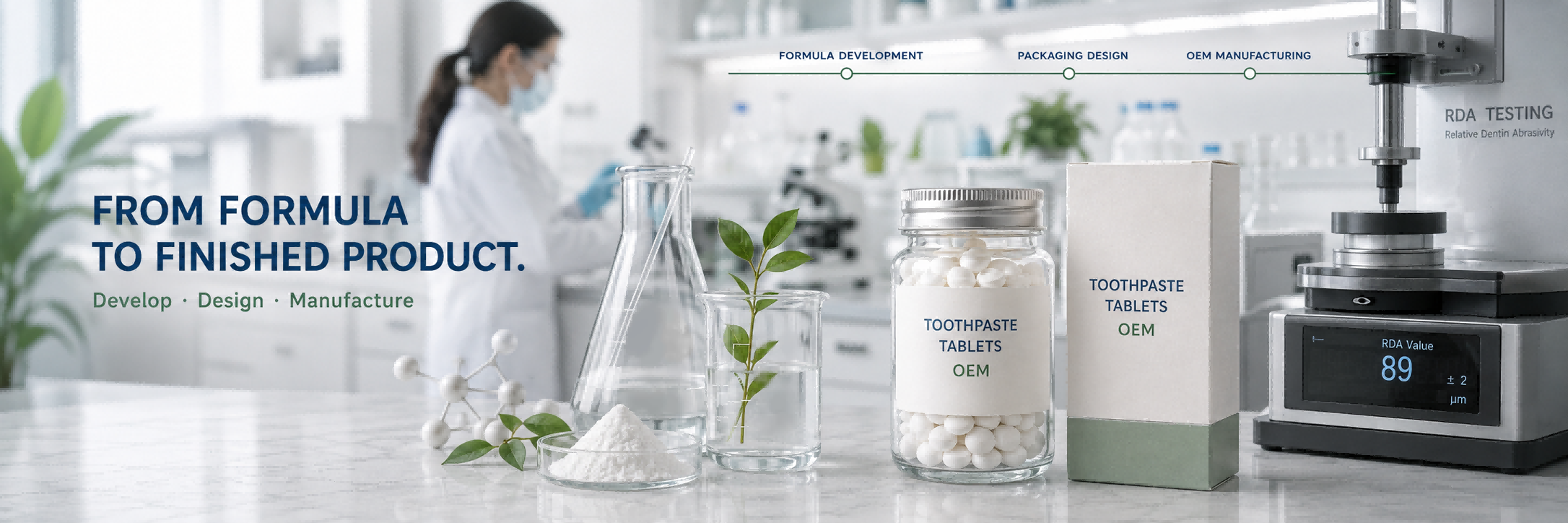
Before export, the botanical story, physical package, and market-facing wording should be reviewed together—not approved as separate tasks.
Regulatory Compliance: What Herbal Toothpaste Tablet Brands Must Avoid
A botanical story is not a license to imply a medical result. Avoid claims such as “treats inflamed gums,” “heals mouth ulcers,” “removes internal heat,” “detoxifies the mouth,” “prevents cavities,” or “replaces brushing and flossing.” FDA explains that the intended use established by claims can determine whether a product is regulated as a cosmetic, a drug, or both.[2]
Evidence for herbal oral-care products is also heterogeneous. An overview of systematic reviews noted variation in products, comparators, and study quality, which is one reason brands should not convert general botanical interest into a guaranteed clinical outcome.[4] Instead, use a 2-step claims review: confirm that the words accurately describe the product’s sensory or cosmetic role, then confirm that evidence and local rules support the final market copy.
Safer global language includes “botanical oral wellness ritual,” “cooling botanical sensory profile,” “tea-inspired freshness,” “plant-forward oral care,” and “designed for daily brushing.” Final claims should be reviewed for every target country before launch.
How to Evaluate a Herbal Toothpaste Tablets Manufacturer for Global Launches (Checklist)
A qualified botanical toothpaste OEM should help a brand evaluate more than the tablet formula. Request a 5-part launch file: a cultural-translation brief, a formula and flavor brief, a claims matrix, a sample and sensory record, and an export-pack copy plan.
The manufacturer should also be able to explain how the chosen concept will remain consistent through 3 stages: prototype sample, final packaging artwork, and mass-production release. Ask whether the team can review front-label and marketplace language against the intended formula story, flag prohibited claim directions, and keep the actual tablet’s color, flavor, and botanical identity aligned with the approved positioning.
At Qiaoerna, our private label herbal toothpaste tablets OEM process can connect Chinese botanical inspiration with market-ready language. We can structure 3 positioning routes—Cooling Botanical, Tea-Inspired Freshness, or Gentle Botanical Daily Care—then align the flavor brief, sample feedback, and export-pack copy plan before mass production. To request a sample or discuss your global private label project, contact admin@qiaoerna.com.cn.
FAQ: Private Label Herbal Toothpaste Tablets MOQ, Sampling & Certifications
What is the MOQ for private label herbal toothpaste tablets?
MOQ depends on the formula, tablet specification, flavor direction, jar or pouch, printed carton, and target market. Ask the OEM to separate product MOQ, primary-packaging MOQ, and printed-carton MOQ so that the first order is commercially transparent.
How long does sampling take and what should brands test?
Sampling time depends on formula direction, flavor development, packaging availability, and claims review. A useful sample program should test at least 3 points: whether the tablet experience matches the chosen sensory route, whether the front-label story accurately describes it, and whether the target-market wording remains appropriate.
What certifications and documents should a botanical toothpaste OEM provide?
Request the quality-system documentation, raw-material specifications, batch records, finished-product testing scope, label-review support, and any market-specific documents required for the final product category. Certification requirements vary by country; match documents to the formula and claims rather than relying on a generic list.
Can we customize the botanical story, formula, flavor, and packaging?
Yes. But customization should be approved as one positioning system. A new flavor, plant story, tablet color, jar, or export market can change the language that is appropriate on the label. Review the 5-part launch file again whenever one of those elements changes.
What is the lead time for mass production?
Lead time depends on formula approval, sample confirmation, packaging procurement, artwork approval, market-copy review, production scheduling, and final inspection. Ask for these as separate milestones instead of accepting one unexplained delivery date.
Related Products
References
[1] Pan MH, Chen WJ, Ho CT. (2020). “Shanghuo, a Traditional Chinese Medicine Theory: Modern Significance of an Old Concept.” Journal of Ethnopharmacology. PMID: 31863858. URL: https://pubmed.ncbi.nlm.nih.gov/31863858/
→ Key finding: Shanghuo is a concept grounded in Traditional Chinese Medicine theory; it should be presented internationally as cultural context, not as a directly transferable biomedical claim.[2] U.S. Food and Drug Administration. (2024). “Is It a Cosmetic, a Drug, or Both? (Or Is It Soap?).” FDA — Cosmetics Laws & Regulations. Content current as of September 11, 2024. URL: https://www.fda.gov/cosmetics/cosmetics-laws-regulations/it-cosmetic-drug-or-both-or-it-soap
→ Regulatory basis: Product classification follows intended use; claims to cure, treat, prevent disease, or affect body structure or function can trigger drug regulation.[3] European Commission. (2017). “Technical Document on Cosmetic Claims.” Supporting Commission Regulation (EU) No 655/2013. URL: https://webgate.ec.europa.eu/circabc-ewpp/rest/download/83d29cfc-b5c8-4496-bee3-2e25f08e2e73
→ Regulatory basis: Cosmetic claims are evaluated against six common criteria including legal compliance, truthfulness, evidential support, honesty, fairness, and informed decision-making.[4] Mehta V, et al. (2024). “Effectiveness of herbal oral care products in reducing dental plaque and gingivitis: an overview of systematic reviews.” Journal source via PubMed Central. URL: https://pmc.ncbi.nlm.nih.gov/articles/PMC11223638/
→ Key finding: Evidence across herbal oral-care products is heterogeneous, reinforcing the need to avoid turning a broad botanical story into a guaranteed clinical claim.![Pink & White Color-Dual Toothpaste Tablets Sensitive Repair]()
![Plantain Toothpaste Tablets Herbal Gentle Clean Waterless Oral Care OEM ODM]()
![Nettle Mint Toothpaste Tablets Herbal Fresh Clean Waterless Oral Care OEM ODM]()
![Ginger & Herbal Enamel Care Toothpaste Tablets With Hydroxyapatite, Oak Bark & Clove Oil]()
![Herbal Fresh Breath Toothpaste Tablets for Daily Oral Care | Plant-Based Solid Toothpaste]()


